Cheap vs Expensive Air Fryers: What Does the Extra Money Buy?
This post contains affiliate links. As an Amazon Associate, BuyerGuideLab earns from qualifying purchases — at no extra cost to you. It never changes a verdict. How we make money.
A 2.6-quart air fryer costs about $50. A dual-basket Ninja costs about $220. Both blow hot air at food in a basket, and both will crisp a tray of frozen fries to roughly the same colour. So what does four times the money actually buy — and at what point does paying more stop making your dinner better?
Short answer: the jump from about $50 to about $100 buys real things — usable capacity, a wider temperature range, a better basket coating and much less noise. Above roughly $120 you are mostly buying capacity and convenience, not better cooking. For most households the sweet spot is a 6-quart machine around $100.
The three price bands
- Budget, around $60Chefman 4-QuartCheck price →
- Sweet spot, around $100Cosori TurboBlaze 6-QuartCheck price →
- Premium, around $220Ninja DualZone 8-QuartCheck price →
What changes as the price goes up
| Around $50–60 | Around $90–110 | $170 and up | |
|---|---|---|---|
| Usable capacity | 2.6–4 qt, one or two servings | 5–6 qt, a small chicken or dinner for 3–4 | 7–8 qt, or two baskets |
| Temperature range | Typically 200–400°F | Roughly 90–450°F | Roughly 105–450°F |
| Low-temp modes | No | Dehydrate, proof, keep warm | Dehydrate, proof, plus dual-zone timing |
| Basket coating | Basic non-stick | Better non-stick or PFAS-free ceramic | Good non-stick, sometimes ceramic |
| Noise | Loudest for its size | Quietest band, some rated near 53 dB | Loud again — bigger fans |
| Controls | Dial or simple buttons | Digital with presets and shake reminder | Digital, plus syncing two baskets |
| Build | Light plastic, flimsy drawer | Solid drawer, steadier handle | Heaviest, best drawer action |
The five things that genuinely differ
1. Temperature range, not maximum heat
Nearly every air fryer reaches 400°F, which is all you need for fries and wings. The difference is the bottom of the range. Cheap machines start at about 200°F; better ones go down to 90–105°F, which is what makes dehydrating fruit, proving dough and gentle reheating possible. If you only cook frozen food, this changes nothing. If you want the machine to do more than crisp, it is the single biggest upgrade.
2. Usable capacity, not the number on the box
Air fryers cook by moving air around food, so a basket works well at about half its stated volume in a single layer. A 4-quart basket realistically feeds two; a 6-quart feeds three or four; an 8-quart dual basket feeds four to six. Paying more for capacity you do not need means a bigger machine on your counter and longer preheats for the same dinner. Our guide to choosing the right air fryer size has the numbers by household.
3. The basket coating
This is where cheap machines really are cheap. Budget baskets use a thin non-stick that starts sticking within a year or two of regular use, and once it goes the machine is unpleasant to clean. Around the $100 mark you get either a thicker non-stick or a PFAS-free ceramic coating, which is the honest reason to spend the extra money — the coating, not the wattage, is what usually ends an air fryer’s life.
4. Noise
Cheap air fryers are loud, and so are the biggest expensive ones, because both push a lot of air through a small space. The quietest machines sit in the middle of the market: some 6-quart models are rated around 53 dB, roughly a quiet conversation. If your kitchen opens onto a living room, this is the difference you will notice every day for years.
5. The drawer and the handle
It sounds trivial until you do it twice a day. Budget drawers rattle, sit unevenly and get hot near the handle. Mid-range and premium drawers slide cleanly, seat properly and stay cool where you hold them. This is the part of a cheap air fryer that feels cheap.
What does not improve when you pay more
Crisping on simple food. Frozen fries, wings and nuggets come out very similar from a $60 and a $200 machine. Anyone claiming a dramatic difference on frozen food is selling something.
Presets. “9-in-1” and “12-in-1” are the same heating element with different time and temperature pairs. They are convenient, not capability. You can reproduce any preset with a dial and thirty seconds of attention.
Wattage. Higher wattage mostly tracks bigger baskets, not faster cooking. A 1,750 W 8-quart machine is not hotter than a 1,500 W 5-quart one; it simply has more air to heat.
Windows and lights. Nice to have, often fogged in practice, and no substitute for pulling the drawer out to look — which you can do at any price without interrupting the cook.
How we judged these: we compare published specifications, verified owner reviews and long-term reliability reports rather than claiming hands-on testing. Where a figure comes from the manufacturer, we say so. Product boxes show live Amazon prices. Our methodology →
Our picks in each price band

Chefman 4-Quart Compact Air Fryer
Best for: One or two people, a dorm or an office kitchen, or a first air fryer you are not sure you will use.
- 4 qt
- Compact footprint
- Digital controls
- Dishwasher-safe basket
- Easy-view window
What we like
- Genuinely small — fits where a 6-quart will not
- Enough for two portions of fries or two chicken breasts
- Cheap enough to treat as an experiment
Watch out for
- Basic coating that will not stay slick for years
- No low-temperature modes for dehydrating or proving
- Loud for its size
✓ Worth ItThe right buy if space or budget is the constraint — just do not expect the coating to last.
Check price on Amazon →
Cosori TurboBlaze 6-Quart
Best for: Most households of two to four. This is the band where paying more stops paying you back.
- 6 qt
- 1,725 W
- 90–450°F
- 5 fan speeds
- 9 functions
- PFAS-free ceramic basket
What we like
- Wide temperature range, including genuine low-temperature modes
- PFAS-free ceramic coating instead of basic non-stick
- One of the quieter machines on the market
- Fits a small chicken or dinner for four
Watch out for
- Still a single basket — no cooking two things two ways
- Ceramic coatings are consumables, however careful you are
✓ Worth ItThe machine we would buy with our own money. Almost everything above it costs more for capacity, not for better cooking.
Check price on Amazon →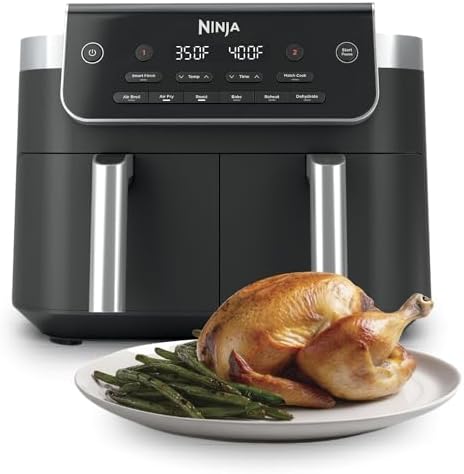
Ninja DualZone 8-Quart (DZ801)
Best for: Families of four or more who want a main and a side finished at the same moment.
- 2 × 4 qt baskets
- 1,750 W
- 105–450°F
- 6 functions
- Smart Finish
- Match Cook
What we like
- Two baskets, two temperatures, timed to finish together
- Match Cook turns it into one large 8-quart batch
- Heaviest, best-built drawers of the three
Watch out for
- Wide footprint — measure your counter first
- Each basket is only 4 qt, too narrow for a whole chicken
- Loud, and expensive if you never use the second basket
✓ Worth ItWorth the money only for the dual-basket trick. As a single big air fryer, it is poor value.
Check price on Amazon →Which band should you buy?
One or two people, tight counter: the budget band is fine. Buy the smallest machine you will actually fill and accept that it is a three-year appliance.
Two to four people, cooking most nights: spend about $100. You get the coating, the temperature range and the quiet, and nothing above this band will make your food better.
Four or more, or you cook a main and a side together: the premium dual-basket machines earn their price — but only for that feature. If you just want one big basket, a 6.5-quart single costs far less.
Still choosing between brands rather than price bands? Our Ninja vs Cosori comparison and the best air fryers under $100 go deeper on specific models.
The verdict
Air fryers hit diminishing returns fast. Everything that matters for cooking — a wide temperature range, a coating that lasts, a basket you can fill, and a machine quiet enough to run at dinner time — is available for around $100. Below that you are trading away the coating and the low-temperature modes; above it you are buying capacity and convenience.
Buy the cheapest machine that fits your household, not the cheapest machine on the shelf, and put the money you save into using it.
Frequently asked questions
Are expensive air fryers actually better?
For cooking, only up to a point. Paying up to about $100 buys a wider temperature range, a better basket coating, more usable capacity and less noise. Above that, extra money mostly buys capacity and convenience features, not better results.
What is the difference between a cheap and an expensive basket air fryer?
Cheap models have smaller baskets, a narrower temperature range that usually starts around 200°F, thinner non-stick coatings, louder fans and flimsier drawers. Mid-range models fix all five. Premium models add capacity, dual baskets and better build.
Is a $50 air fryer worth buying?
Yes, if you cook for one or two, have little counter space, or are not sure you will use it. Expect the coating to fade within a couple of years and expect it to be loud.
Do more expensive air fryers cook faster?
No. Higher wattage generally tracks a bigger basket rather than more heat. A large premium machine often takes longer to preheat than a small cheap one.
How much should I spend on an air fryer?
About $100 for most households of two to four. That is the band where capacity, coating quality, temperature range and noise are all good, and where extra spending stops improving the food.