What Does “PFAS-Free” Actually Mean? A Buyer’s Guide to Safety Claims
This post contains affiliate links. As an Amazon Associate, BuyerGuideLab earns from qualifying purchases — at no extra cost to you.
“PFAS-free” is stamped on everything from cookware to raincoats now, but the term gets thrown around loosely enough that it’s worth breaking down what it actually promises — and what it doesn’t.
What “PFAS-Free” Actually Means
1. PFAS is a class of thousands of chemicals, not one thing.
Per- and polyfluoroalkyl substances (PFAS) are a large family of synthetic chemicals used for decades in nonstick coatings, waterproofing, and stain resistance. Teflon’s PTFE is one specific PFAS compound.
2. “PFAS-free” means the coating doesn’t use these chemicals at all.
Ceramic nonstick coatings (like those from GreenPan and Caraway) use a silica-based sol-gel process instead of PTFE, so they can legitimately claim PFAS-free status.
3. It’s different from “PFOA-free.”
PFOA was a specific PFAS chemical (perfluorooctanoic acid) once used in manufacturing Teflon, phased out in the US by 2013. Modern Teflon is PFOA-free but still technically PFAS, since PTFE itself is a PFAS compound.
4. Look for third-party verification, not just marketing copy.
Reputable brands disclose testing methodology or certifications. A vague “eco-friendly nonstick” claim with no specifics is a yellow flag.
Quick Comparison Table
| Claim | What It Means | Trust Level |
|---|---|---|
| PFAS-free | No PFAS chemicals used at all (e.g. ceramic coatings) | High, if brand discloses coating type |
| PFOA-free | Missing one specific PFAS chemical, may still contain PTFE | Medium — still PFAS technically |
| “Eco nonstick” (vague) | Unregulated marketing term, no specific meaning | Low — verify separately |
Genuinely PFAS-Free Options
Prices and availability are pulled live from Amazon and update automatically — always confirmed at the moment you click through.


Recommended Picks
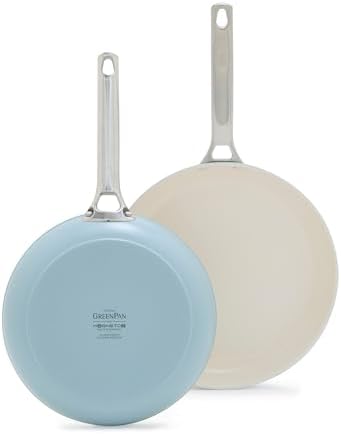
GreenPan Ceramic Nonstick
Uses Thermolon, a mineral-derived ceramic coating that’s genuinely PFAS-free and independently one of the original ceramic nonstick brands on the market.
Caraway Ceramic Cookware
PFAS, PTFE, lead, and cadmium-free ceramic coating with clear labeling on their materials — a straightforward option if you want certainty without researching each pan.
Stainless Steel Cookware
Not a coating at all, so the PFAS question doesn’t apply. If you want zero uncertainty, uncoated stainless steel sidesteps the entire category.
FAQ
Is PFAS-free cookware actually safer than Teflon?
Modern Teflon (post-2013) is PFOA-free and considered safe under normal cooking temperatures by regulatory bodies, but it still contains PTFE, a PFAS compound, and can release fumes if overheated. PFAS-free ceramic coatings avoid this chemical family entirely.
Does PFAS-free mean the pan lasts as long as Teflon?
No — ceramic nonstick coatings typically lose their nonstick properties faster (2-4 years) than well-maintained PTFE coatings, regardless of the safety difference.
Are PFAS chemicals actually banned?
Some specific PFAS compounds (like PFOA) have been phased out or restricted in the US and EU, but PFAS as a broad chemical class is not universally banned, and regulation varies significantly by country and use case.
How can I verify a “PFAS-free” claim myself?
Look for the brand naming its actual coating technology (e.g., “Thermolon,” “sol-gel ceramic”) rather than just the phrase “eco-friendly,” and check if they publish third-party lab test results.